

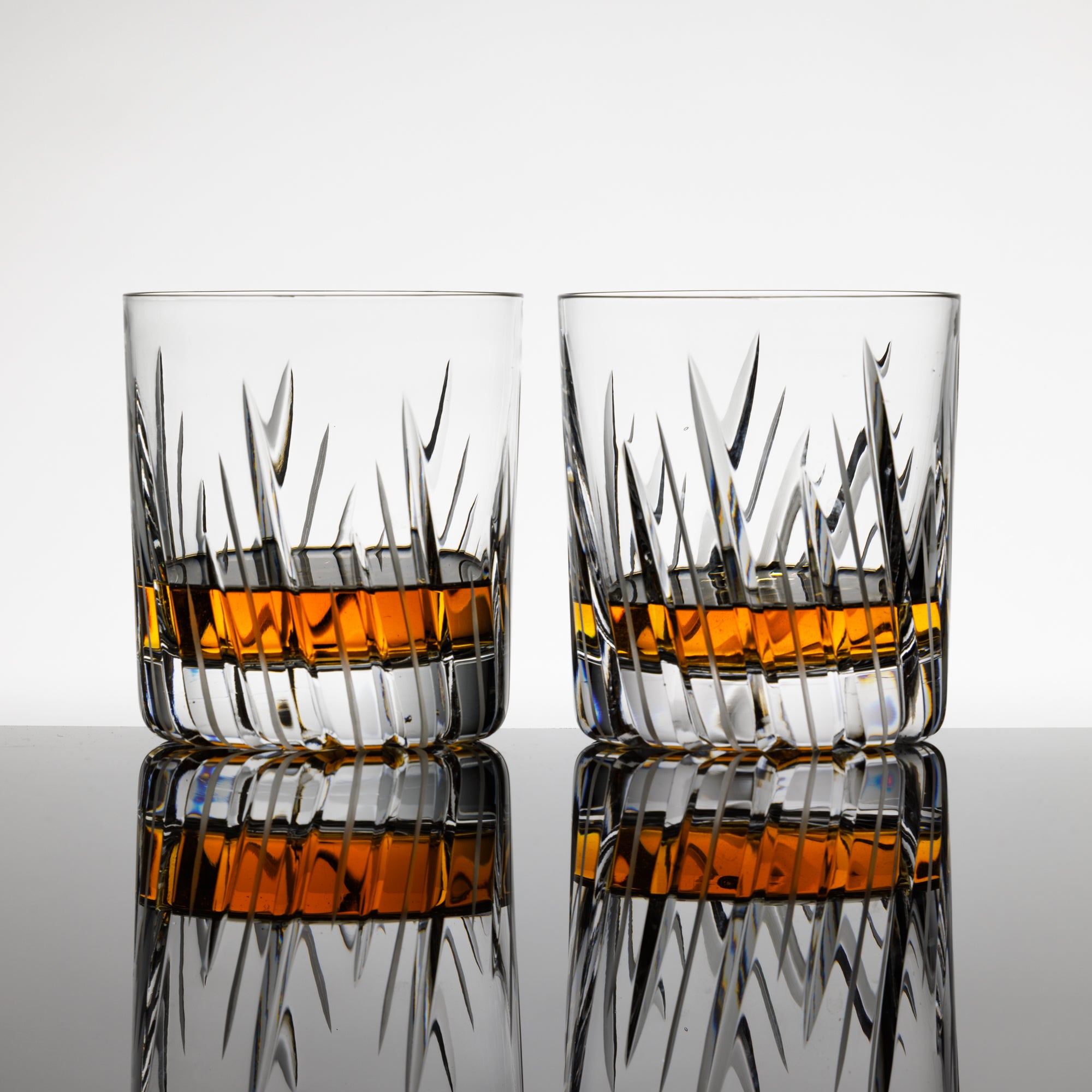
How to identify genuine, handcrafted, traditional lead crystal
What makes traditional lead crystal different to mass-produced glass & how to identify it
Written by Chris Blade MA (RCA), CEO, Cumbria Crystal

Raw materials melting in a furnace at 2400 degrees centigrade
As few people have detailed knowledge about hand-made lead crystal and what differentiates it from mass-produced, machine made, products we hope this information will be of interest and increase your understanding and appreciation of lead crystal.
Lead crystal, invented in England in the 1680s by George Ravenscroft, revolutionised the glass industry globally. The addition of red lead oxide to glass (historically between 24% & 36% by weight) changed the whole industry. It helped make glass clearer, melt at lower temperatures and add weight to the material. This weight alters the refractive index of the glass meaning it can bend light more than other glasses, hence it was clearer and sparkled more!
Due to the popularity & prestige of crystal in the 18th Century the English government imposed high taxes on crystal leading to design evolutions & bizarre taxes such as the window tax which led people aspiring to show wealth to paint windows on their houses where there were no windows.
The advantage of lead-crystal over more soda-lime glass, or today’s commonly used barium-based glass (for tableware), is that the chemical composition of the material makes it particularly suitable for hand-cutting designs, using diamond & sandstone wheels, on a lathe. It also polishes extremely well using concentrated hydrofluoric and sulphuric acids. Only two companies in the UK still do this.
The use of lead oxide to create genuine ‘lead crystal’, historically referred to as flint glass, has several production, health, and financial challenges over other glasses. Whilst emulating historic techniques where possible possible, Cumbria Crystal and its parters achieve a quality far in excess to anything achieved by glass Masters of the past. Consequently most modern manufacturers have sadly abandoned lead crystal.
Why?
1) cost - the raw materials for lead crystal are far more expensive than other glasses;
2) it is more difficult to blow than modern materials, reducing production yields and increasing costs.
3) it has a long working-life meaning it is slower to work than modern materials as it stays malleable longer;
4) traditional furnaces take two days to melt the raw materials. In larger factories it is often melted overnight, if using crucibles, or in continuous melt furnaces which do not require down-time.
5) crystal melted in traditional furnaces is prone to some lead evaporation from the surface of the molten glass. This can slightly alter the refractive index of the crystal resulting in an optical effect, most visible in thicker sections of products, known as cord.
6) the safety of the glassblowing team - prior to melting when the glass is in a raw, un-melted state, lead oxide can be absorbed into the body (via the skin, inhalation or ingestion) with potential health implications long term. It should be noted that once melted crystal if safe for general use.

Glassblower, Andrew Round, preparing the raw material (batch)
Today only a few companies in the world still produce lead crystal. In the quest for better consistency and efficiency some use modern, continuous-melt, tank furnaces. The advantage is that the larger volume of crystal and slow continuous movement of the material helps expel small bubbles, minimise cord and reduce running costs.
Other contemporary approaches to producing glass completely free of bubbles and cord (although not usually lead crystal), is to melt the raw materials in platinum crucibles and to stir the mixture slowly until it is thoroughly mixed and melted. Molten glass does not adhere to platinum, or degrade with the heat, so it is perfectly suited for this. This approach enables the production of stunning optical quality glass, but at a mind-boggling cost. Even smallish crucibles can be upwards of $2M and stirring blades $500,000 each. This process is therefore reserved for specialist items such as camera lenses.

The melting process at the beginning
Bubbles, cord and stone (within reason) are defining characteristics of crystal. This is most obvious when melted in a traditional small furnace. Most questions we receive about lead crystal relate to this. No glass melted using traditional processes is free of these since the glass is static in a traditional furnace. If one were to study the most expensive antique English crystal, from the hay-day of English crystal making in the 17th, 18th & 19th Centuries, these characteristics will always be seen. Despite manufacturers’ best efforts these characteristics of crystal are sometimes mistaken for flaws, rather than it being understood that they validate the integrity of the material. Since most people’s experience is limited to modern mass-produced glass produced in hundreds-of-thousands, or millions, by automated processes this is hardly surprising.
Other contemporary approach to producing glass completely free of bubbles and cord (although not usually lead crystal), is to melt the raw materials in platinum crucibles and to stir the mixture slowly until it is thoroughly mixed and melted. Molten glass does not adhere to platinum, or degrade with the heat, so it is perfectly suited for this. This approach enables the production of stunning optical quality glass, but at a mind-boggling cost. Even smallish crucibles can be upwards of $2M and stirring blades $500,000 each. This process is therefore reserved for specialist items such as camera lenses.
Bubbles: Glass melted in hand-made, clay, closed pot-furnaces stays static in the pot until it is used. Imagine filling a bucket with water and taking it out one cup at a time.
At the end of the week unused crystal is ladled out, fritted in large vats of cold water and then recycled with new raw materials for the following week. Uncontaminated glass, rather like gold, can be recycled indefinitely. Typically the highest quality glass is achieved by recycling around 30% of the total material.
To minimise the occurrence of bubbles, raw materials are typically melted over a two-day period. By extending the melting time more fine bubbles can reach the surface and dissipate. Even at temperatures of 1450 centigrade the glass is still viscous and not all bubbles ever reach the surface. Special ceramic rings are often floated on the surface of the crystal, and glass is gathered on the blowing iron, from the centre. This can reduce, but not completely stop, the number of bubbles gathered. Unsurprisingly, in the extreme environment (1240 degrees centigrade), the rings slowly degrade and eventually become a source for small particles of ceramic to enter the crystal! – these are called stone.
Stone: Usually observed as microscopic ceramic elements that have flaked off the rings, ceramic crucible, or fire bricks from the furnace itself due, to the heat and corrosive chemical action of the melting process. Stone looks like tiny white or black, flecks embedded in the crystal. Traditional pots generally last 3-6 months before requiring replacement. Even with brand new pots stone cannot be eliminated. Tank furnaces can last for many years, so produce more consistent quality and less stone.
Cord: Cord is a thin, but visible, difference in the refractive index of the glass. It causes light to refract inside the glass in a wispy manner. This is most commonly visible in the thickest sections of a crystal product, such as the base. Cord is one of the defining characteristics of lead-crystal since and is inherent in manufacturing process.
Cord is not unique to lead-crystal and does appear in other types of glass. The cord effect is primarily caused by surface evaporation of lead from the liquid glass whilst it is waiting to be used. Whilst evaporation is minimal the chemical composition of the glass changes, microscopically altering the refractive index of the material on the surface. When the glassblower gathers crystal, by dipping a blowing iron into the glass and rotating it, the surface layer mixes with the glass underneath, creating a slight variation in the composition of the glass. This happens continuously but is more common after a short break, or towards the end of a working day. Gently movement of the glass whilst liquid helps homogenise the glass, minimising the effect. Tank furnaces are very good at this as the glass is always in a slow-motion state. On cooling, changes in refractive index become apparent. The effect is most visible In areas where the glass is thick ie. bases of glasses or decanters. In traditional furnaces glassblowers minimise this by raking the surface between gathers. This helps, but does not eliminate it.
Colour: English lead crystal was traditionally made using 36% lead oxide (flint glass). Over the centuries this was slowly reduced, driven by environmental and cost pressures. Sadly, 30% & 36% full-lead crystal is increasingly rare. Higher lead-content recipes can often be identified as the higher lead content crystal tends to be slightly less ‘bright’ than modern recipes.
On occasion some 'Outlet' (discounted price) products may be part/produced by an EU partner in 30% crystal prior to being being cut and polished by hand using traditional processes.
For information: In Cumbria Crystal evaporated lead is captured from exhaust gasses and filtered before reaching the atmosphere. Once melted, lead oxide becomes chemically bound into the crystal, so it is safe for general use.